
Dog Enrichment: Mental Stimulation Ideas That Go Beyond Puzzle Toys
Your dog gets walks, gets fed, and has a basket of toys they ignore. They are still restless, still getting into things, and still driving you a little bit nuts. The missing ingredient is not more exercise. It is enrichment, and most dogs are not getting nearly enough of it.
What Enrichment Actually Means
Enrichment is any activity that allows your dog to engage their brain, use their senses, and express natural behaviors. The term comes from the zoo world, where animal care professionals realized that providing food and shelter was not enough to keep animals healthy. Animals need to do things: forage, explore, solve problems, make choices. The same is true for your dog.
The internet has reduced enrichment to a shopping list of puzzle toys, and while puzzle toys are great, they are one small slice of what your dog needs. True enrichment spans five categories: food-based enrichment, sensory enrichment (especially scent), cognitive enrichment (training and problem-solving), environmental enrichment (novel places and experiences), and social enrichment (appropriate interactions with other dogs and people). A well-enriched dog gets some combination of all five on a regular basis.
Here is why this matters: a dog who is not mentally stimulated will create their own enrichment, and you will not like it. Destructive chewing, excessive barking, digging, counter surfing, and restless pacing are all signs of a dog whose brain is under-stimulated. These are not character flaws. They are a dog doing the best they can with an environment that is not meeting their needs. Enrichment is not a bonus for your dog's quality of life. It is a baseline requirement, right alongside food, water, and veterinary care.
Food-Based Enrichment: Ditch the Bowl
The single easiest enrichment upgrade you can make is to stop putting food in a bowl. Your dog's ancestors spent the majority of their waking hours foraging, hunting, and working for every calorie. Dumping kibble into a dish and having it disappear in 90 seconds does nothing for your dog's brain. Making them work for their meals is enrichment that happens twice a day without adding anything to your schedule.
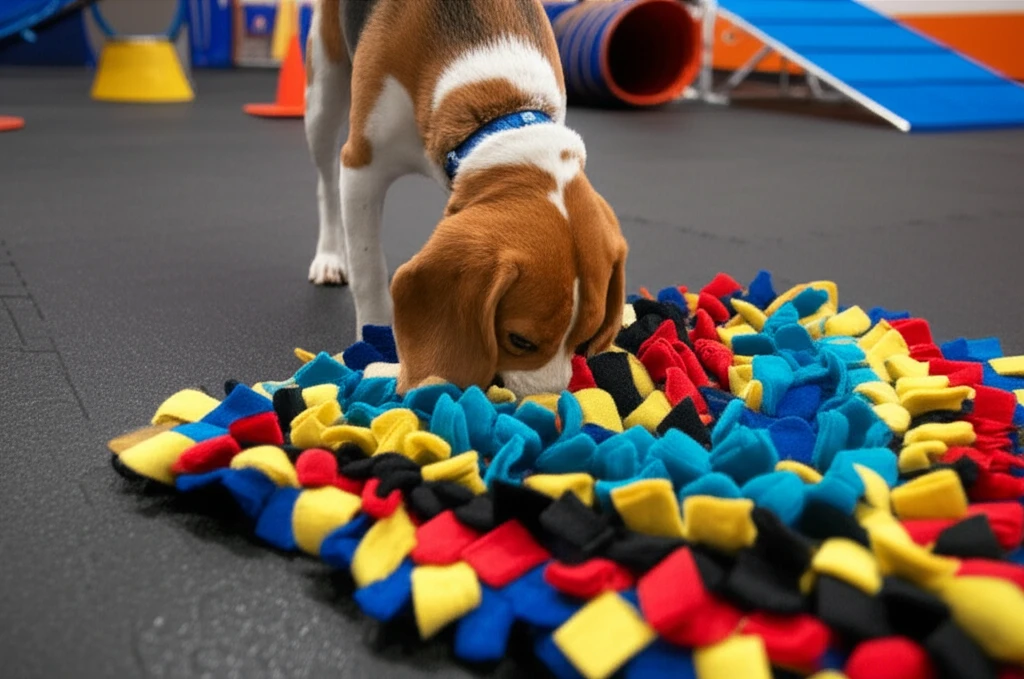
Start simple. Scatter your dog's kibble across the kitchen floor or in the grass and let them sniff it out. This engages the olfactory system and turns a 90-second meal into a 10-minute activity. From there, introduce food puzzles: Kongs stuffed and frozen with a mixture of wet food and kibble, snuffle mats that hide food in fabric folds, rolling dispensers that release kibble as your dog pushes them around, and multi-step puzzle feeders that require your dog to slide, lift, or spin components to access food.
The key is matching difficulty to your dog's experience. A dog who has never used a food puzzle needs to start with something easy and obvious, like a Kong smeared with peanut butter, so they learn that interacting with the object produces food. If the puzzle is too hard, they will give up and walk away, and that is frustrating rather than enriching. Build difficulty gradually over weeks, and rotate puzzles so they stay novel. A dedicated guide to puzzle toys and food enrichment can help you build a rotation that keeps meals interesting without overwhelming your dog.
Scent Work and Sensory Enrichment
Your dog's nose is their superpower. Dogs have up to 300 million olfactory receptors compared to your six million, and the part of their brain dedicated to processing scent is proportionally 40 times larger than yours. When you walk down the street, you see the world. Your dog smells it, in layers of detail you cannot imagine. And yet most pet dogs rarely get the opportunity to use this extraordinary system in any meaningful way.
Scent work is the most accessible and underrated form of enrichment. At its simplest, it means hiding treats around your house and letting your dog find them. Put your dog in another room, place treats behind furniture, under cups, and on low shelves, then release them to search. You will see your dog's entire demeanor change as they shift into search mode: tail up, nose working, body moving with purpose. Ten minutes of this is mentally equivalent to a 30-minute walk.
Sensory enrichment extends beyond scent. Novel textures underfoot (walking across a wooden pallet, stepping on a tarp, navigating a pile of crinkly water bottles in a kiddie pool), novel sounds played at low volume, and visual novelty like a new walking route all give your dog's brain something fresh to process. Dogs who walk the same loop at the same time every day get physical exercise but very little sensory enrichment. Varying your route, your pace, and the environments you expose your dog to makes every walk more enriching without adding a single minute.
Training as Enrichment
Training is not just about teaching your dog to sit and stay. It is one of the most powerful enrichment activities available, because it engages your dog's problem-solving ability, builds communication between you, and provides the kind of focused mental effort that tires a dog out faster than physical exercise alone.
Think of it this way: a five-minute training session where your dog is actively thinking, making choices, and earning reinforcement is more cognitively demanding than 20 minutes of fetch. Fetch is physically tiring but mentally repetitive. Training asks your dog to figure something out, which is the definition of enrichment.
You do not need to work on formal obedience to get the enrichment benefit. Trick training, shaping games (where you reward successive approximations of a new behavior), and impulse control exercises are all mentally demanding and fun. Teach your dog to spin, to bow, to touch a target with their nose, to back up, to weave between your legs. Chain several tricks into a sequence. The more creative and novel the training, the more enriching it is.
Group classes amplify the enrichment because they add environmental complexity. Training in a new space with other dogs and handlers in the room is harder than training in your living room, and that added difficulty makes your dog's brain work even harder. An indoor training gym provides exactly this kind of structured complexity: a controlled environment where your dog practices skills in the presence of real-world distractions, with a trainer coaching you through it.
Signs Your Dog Needs More Enrichment
Dogs rarely tell you they are bored in ways that are easy to interpret. Instead, they communicate through behavior that people misread as misbehavior. If your dog is showing any of the following patterns, there is a good chance enrichment is the missing piece.
Restlessness and inability to settle. Your dog paces, follows you room to room, cannot lie down and relax even after exercise. This is not hyperactivity or a lack of physical exercise in most cases. It is a brain that has nothing to do and does not know how to turn off. Structured enrichment, especially food puzzles and settle-on-mat training, teaches your dog how to be calm by giving their brain an appropriate occupation.
Destructive behavior when left alone. If your dog is shredding, chewing, or dismantling things in your absence and does not show signs of separation anxiety (panting, drooling, frantic attempts to escape), they are probably bored. Adding an enrichment routine before you leave, a stuffed frozen Kong, a scatter feed, a brief training session, gives them an appropriate activity and transitions them into a calmer state.
Attention-seeking behaviors like demand barking, pawing at you, dropping toys in your lap incessantly, and nudging your hand are all variations of a dog saying "I need something to do." These behaviors are self-reinforcing when they get any response, even a negative one. Providing proactive enrichment throughout the day reduces the need for your dog to manufacture their own entertainment at your expense.
The good news is that enrichment is cumulative. You do not need to overhaul your entire routine overnight. Adding one enrichment activity per day, whether it is a food puzzle at breakfast, a five-minute training session after lunch, or a new walking route in the evening, will produce noticeable changes in your dog's behavior within a week or two. At Zoom Room, our classes are designed to provide enrichment in every session through agility, scent work, tricks, and structured socialization. Find a Zoom Room near you and give your dog's brain the workout it has been asking for.
Frequently Asked Questions
How much enrichment does my dog need every day?
Most dogs benefit from 20 to 40 minutes of dedicated enrichment activities per day, broken into multiple sessions. This does not need to be a big production. A 10-minute food puzzle at breakfast, a 5-minute training session in the afternoon, and a sniff-focused walk in the evening can be enough to make a significant difference. High-energy breeds, adolescent dogs, and working breeds may need more. The best gauge is your dog's behavior: if they are settling calmly between activities and not creating their own entertainment, their enrichment needs are being met.
Is enrichment different from exercise?
Yes, and this is a critical distinction. Exercise works your dog's body. Enrichment works your dog's brain. A long run in the park is physically tiring but mentally repetitive. A 10-minute scent work session is physically easy but mentally exhausting. Dogs need both, but most pet dogs get far more physical exercise than mental stimulation. A balanced routine includes physical activity, mental challenges like food puzzles and training, and sensory experiences like novel environments. When behavior problems persist despite plenty of exercise, insufficient enrichment is almost always the missing variable.
Can you over-enrich a dog?
It is possible but uncommon. Signs of overstimulation include a dog who cannot settle down even after enrichment activities end, one who becomes frantic or frustrated with puzzles rather than engaged, or one who seems more wound up after activities instead of calmer. If this happens, scale back the intensity and duration of activities and make sure you are including calm enrichment like lick mats and snuffle mats alongside more active options. Most dogs self-regulate well when enrichment is introduced gradually and includes a mix of stimulating and soothing activities.
Ready to Enrich Your Dog's Life?
Zoom Room's classes are built around enrichment: agility, scent work, tricks, and structured socialization that challenge your dog's brain in a supportive environment. You train alongside your dog with real-time coaching from professional trainers.
Find a Zoom Room