
Dog Fitness: Why Canine Conditioning Is About More Than Just Walks
Your dog walks every day, plays fetch on the weekends, and seems fit enough. But ask them to balance on an uneven surface, shift their weight backward, or hold a controlled position for ten seconds, and you will see how much functional fitness they are missing. Canine conditioning fills those gaps, and it matters more than you think.
Why Walks and Fetch Are Not Enough
Daily walks are cardiovascular exercise. Fetch is repetitive sprinting with sudden stops. Both have value, but neither builds the balanced fitness your dog needs for a long, active, injury-free life. Think about what happens during a typical game of fetch: your dog sprints forward, slams on the brakes, twists to grab the ball, and repeats. The forces involved are enormous, and they are absorbed by joints, tendons, and ligaments that may not have the supporting muscle strength to handle them. This is why ACL tears are one of the most common orthopedic injuries in dogs, and why many of them happen during routine play, not extreme activity.
Canine fitness, also called canine conditioning, addresses the components of physical health that walks and fetch miss: core strength, balance, proprioception (body awareness), flexibility, and controlled movement. These are the same principles that drive human physical therapy and athletic conditioning, applied to dogs. A dog with strong core muscles, good balance, and awareness of their body in space is less likely to injure themselves during everyday activities, recovers faster from the injuries they do sustain, and maintains mobility much longer into their senior years.
This is not just for athletic dogs. Every dog benefits from better fitness, whether they are a weekend agility competitor, a senior dog with stiff joints, a post-surgery patient rebuilding strength, or a young puppy developing the body awareness that will protect them for life. Enrichment is not only about the brain. A well-conditioned body is part of a well-enriched life.
Core Exercises You Can Start Today
You do not need a gym to start building your dog's fitness. These foundational exercises can be done at home with minimal or no equipment.
Weight shifts. With your dog standing on a flat surface, gently press against their shoulder or hip with just enough pressure to make them shift their weight to the opposite side. Hold for a second, release, and let them recenter. Repeat in all four directions: left, right, forward, and backward. This teaches your dog to engage their stabilizer muscles and builds core awareness. It is also a baseline assessment: a dog who cannot maintain their balance with gentle pressure has significant core weakness.
Sit-to-stand transitions. Ask your dog to sit, then immediately lure them into a stand without letting them step forward. The goal is a straight vertical movement from sit to stand, using their hind legs to push up rather than rocking forward. Repeat five to ten times. This strengthens the hindquarters and builds the controlled movement patterns that protect joints during everyday activities like getting off the couch or climbing stairs.
Backing up. Stand facing your dog in a narrow hallway or between two pieces of furniture. Step toward them slowly, rewarding any backward movement. Shape until your dog can back up several steps in a straight line. Backing up is one of the best exercises for hind-end awareness because most dogs almost never move backward in daily life. Their hind legs are essentially on autopilot, and this exercise wakes them up.
Cavaletti rails. Lay four to six poles (broomsticks, PVC pipes, or pool noodles) on the ground, spaced at your dog's shoulder width apart. Walk your dog slowly over the poles on leash. The poles force your dog to pick up their feet deliberately and think about where they are placing each paw. This is one of the simplest and most effective proprioception exercises and is widely used in canine rehabilitation.
Equipment-Based Conditioning
As your dog's fitness improves, adding equipment increases the challenge and targets specific muscle groups and balance systems.
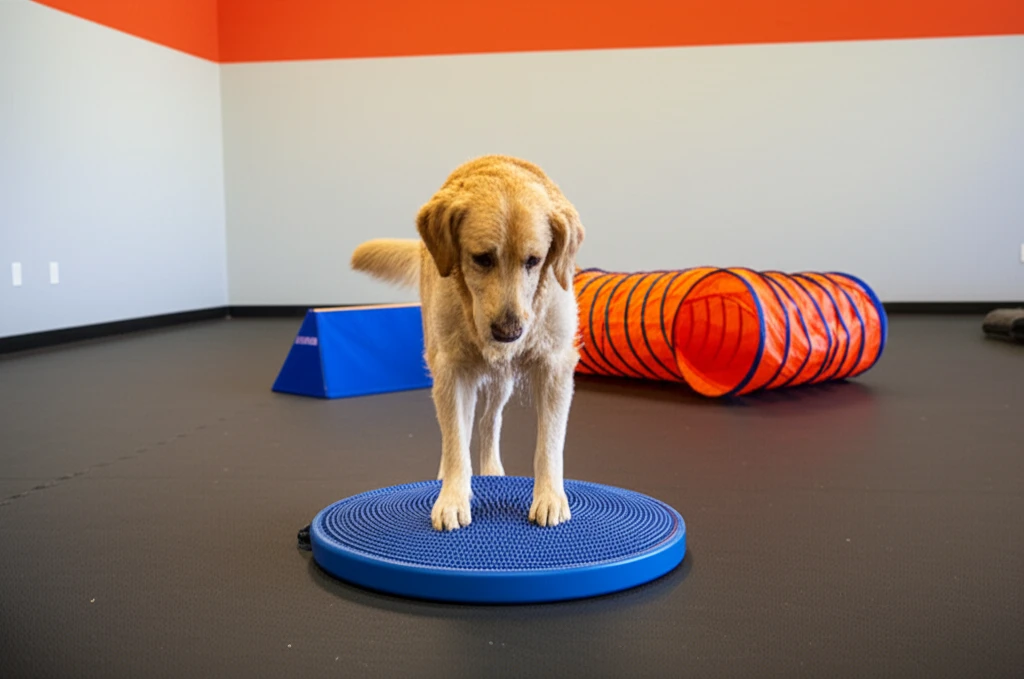
Balance discs and wobble boards. An inflatable balance disc (like a FitPaws disc) placed on the floor creates an unstable surface your dog must work to stand on. Start by rewarding your dog for placing one paw on the disc, then two front paws, then all four. The instability engages core muscles and proprioceptive systems that flat surfaces do not challenge. Wobble boards (a flat board on a pivot point) add a tilting element that requires constant micro-adjustments. These tools are staples of canine rehabilitation and conditioning programs.
Peanut balls and stability balls. A peanut-shaped exercise ball provides a larger, more unstable surface for advanced balance work. Your dog can rest their front paws on the peanut while their hind legs stay on the ground (or vice versa), or more advanced dogs can balance with all four paws on the ball. This level of instability builds deep core strength and full-body coordination. Always spot your dog during ball work to prevent falls.
Raised platforms and step-ups. A low, stable platform (six to twelve inches high) gives your dog a surface to step onto, stand on, and step off of. Front-paw-only step-ups strengthen the shoulders and core. Rear-paw-only step-ups (with the dog backing up onto the platform) target the hindquarters. Full-body step-ups with a hold at the top build overall balance and confidence. This is also excellent preparation for agility obstacles like the pause table and contact equipment.
The critical rule with all equipment work is to progress slowly and never force your dog onto an unstable surface. If your dog is hesitant about a wobble board, start with the board on carpet so it barely moves, and reward any interaction. Confidence on equipment is built through positive experiences and gradual progression, never through pushing a dog past their comfort level.
Fitness for Every Life Stage
Puppies. Young dogs are building their musculoskeletal systems, and their growth plates remain open until 12 to 24 months depending on breed size. High-impact activities (repetitive jumping, long runs on hard surfaces, forced exercise) can damage growing joints. But low-impact conditioning is both safe and beneficial. Body awareness exercises, gentle balance work on stable surfaces, cavaletti walking, and controlled play on varied terrain all help puppies develop the proprioception and coordination that reduce injury risk as they grow. Puppy classes that incorporate body awareness exercises give your puppy a fitness foundation from the start.
Adult dogs. Healthy adult dogs can handle the full range of conditioning exercises. The goal is maintenance and injury prevention. Two to three conditioning sessions per week, 10 to 15 minutes each, will maintain core strength, balance, and flexibility alongside your dog's regular exercise routine. Dogs involved in sports like agility benefit from conditioning that targets the specific physical demands of their activity: strong hindquarters for jumping, core stability for tight turns, and shoulder strength for contact obstacles.
Senior dogs. Fitness becomes even more important as your dog ages, not less. Muscle mass decreases naturally with age (sarcopenia), and weakening muscles put more stress on already-aging joints. Gentle conditioning exercises maintain the muscle support that keeps joints stable and mobile. Balance work helps prevent falls. Flexibility exercises maintain range of motion. A senior dog on a regular conditioning program moves better, plays more, and lives more comfortably than one who is simply walked and left to stiffen. Many rehabilitation veterinarians consider canine conditioning the single most impactful intervention for extending quality of life in senior dogs.
Post-surgery and rehabilitation. Dogs recovering from orthopedic surgery (ACL repair, fracture fixation, hip replacement) need structured reconditioning to rebuild strength and function. This should always be done under the guidance of a veterinary rehabilitation professional. The exercises are similar to general conditioning but with specific protocols for the injury, controlled progression, and close monitoring for pain or compensation. If your dog is in rehab, ask their veterinarian about transitioning to general fitness conditioning once they are cleared.
Pup-lates and Structured Fitness Classes
You can absolutely build your dog's fitness at home, and the exercises above are a great starting point. But there are advantages to working with a professional, especially when you are learning to assess your dog's form, spot compensation patterns, and progress safely.
An indoor training gym offers a controlled environment with professional-grade equipment: balance discs, wobble boards, cavaletti rails, platforms, and stability balls that would cost hundreds of dollars to assemble at home. More importantly, an instructor can evaluate your dog's current fitness level, identify weaknesses (most dogs have significant hind-end weakness because their front end does most of the work), and design a progression that addresses those gaps without risking injury.
Zoom Room offers Pup-lates, a Pilates-inspired fitness class for dogs. Pup-lates focuses on core strengthening, balance, flexibility, and body awareness using conditioning equipment and guided exercises. You work alongside your dog, learning to spot correct form, reward effort, and keep sessions fun and motivating. The class is suitable for dogs of all ages and fitness levels, with modifications for puppies, seniors, and dogs with physical limitations.
The best fitness program is one your dog enjoys and you do consistently. A 10-minute conditioning session three times a week, done with enthusiasm and treats, will produce significant improvements in your dog's strength, balance, and mobility within a month. That investment pays off for years in fewer injuries, better mobility, and a dog who stays active and comfortable well into old age. Explore Zoom Room's Pup-lates and fitness classes to get your dog started. Find a Zoom Room near you.
Frequently Asked Questions
How often should I do conditioning exercises with my dog?
Two to three sessions per week is ideal for most dogs, with each session lasting 10 to 15 minutes. This is enough to build and maintain core strength, balance, and proprioception without overloading muscles that are still developing. Like human fitness, consistency matters more than intensity. Short, regular sessions produce better results than occasional long ones. Allow at least one rest day between conditioning sessions so muscles can recover and strengthen. On off days, your dog can still walk, play, and train normally. The conditioning sessions supplement rather than replace regular exercise.
Is canine fitness the same as canine rehabilitation?
They overlap but are not identical. Canine rehabilitation (also called veterinary physical therapy) is a medical treatment for dogs recovering from injury, surgery, or managing chronic conditions like arthritis. It is performed under veterinary supervision and uses targeted exercises, manual therapy, hydrotherapy, and other modalities. Canine fitness or conditioning is a wellness practice for healthy dogs aimed at preventing injuries, building strength, and maintaining mobility. The exercises are similar, but conditioning does not require veterinary oversight for healthy dogs. If your dog has an existing injury or medical condition, start with a rehabilitation professional before transitioning to general fitness.
My dog does not like standing on wobbly things. How do I get them started?
Start with the equipment on a surface that minimizes movement, like thick carpet or a yoga mat. Place treats on and around the equipment so your dog chooses to approach and interact with it voluntarily. Reward any investigation: sniffing, touching with a paw, stepping near it. Never place your dog on unstable equipment or force them to stay on it. Let them set the pace. Once they willingly put one paw on a barely-moving disc, you can gradually increase the instability by moving to a harder floor surface. Most dogs who seem reluctant are not afraid of the equipment itself. They are unsure because they have never been asked to balance before. Patience and a high rate of reinforcement solve this quickly.
Ready to Build Your Dog's Fitness?
Zoom Room's Pup-lates classes use professional conditioning equipment and expert instruction to build your dog's core strength, balance, and body awareness. You work alongside your dog in a supportive indoor gym environment.
Find a Zoom Room