
Why Your Dog Loses It When They See Other Dogs on Walks
You're walking your dog. Everything is calm. Then another dog rounds the corner, and yours transforms -- lunging, barking, pulling so hard the leash goes taut. This is leash reactivity, and it's one of the most common and most misunderstood behavior problems in pet dogs.
What's Actually Happening
If this is your dog, you've probably crossed the street more times than you can count. You may dread walks. You may feel embarrassed, frustrated, or worried that something is deeply wrong. Here's the first thing to know: leash reactivity is not a character flaw. It's a pattern that developed for specific reasons, and it can be changed with the right approach.
Most leash-reactive dogs are not aggressive. That distinction matters, because it changes everything about how you respond. The barking and lunging look dramatic, but the motivation behind them usually falls into one of two categories.
Frustration. Your dog wants to get to the other dog. They want to sniff, play, investigate -- but the leash prevents it. The frustration builds, and it comes out as barking and pulling. These are often the same dogs who play beautifully at the dog park or in a socialization setting once they're actually off-leash and free to interact on their own terms.
Fear or anxiety. Your dog is worried about the approaching dog and wants to create distance. Off-leash, they'd arc wide, turn sideways, or simply move away. On-leash, they can't. The only option left is to make themselves look big and loud enough to keep the other dog from coming closer.
In both cases, the leash itself is part of the problem. It removes every natural option a dog has for managing a social encounter. Dogs don't naturally approach each other head-on in a straight line -- that's actually rude in dog body language. They arc, they curve, they sniff from the side. A six-foot leash on a sidewalk turns every passing dog into a forced head-on encounter with no escape route. It's the canine equivalent of being locked in a narrow hallway with a stranger walking straight at you.
What Makes It Worse
Most people respond to leash reactivity in ways that accidentally reinforce it. Not because they're doing anything wrong on purpose -- the instincts that kick in during those moments just happen to make the problem bigger over time.
Tightening the leash. When you see another dog and shorten up, your dog feels the tension travel straight down the leash. Your grip tightens, your arm stiffens, and your dog reads all of it. They learn that you tense up around other dogs, which confirms that other dogs are something to worry about.
Yelling or correcting. When your dog is already in a heightened emotional state -- heart pounding, adrenaline up, focused entirely on the other dog -- adding a leash correction or a sharp "No!" doesn't teach them anything useful. What it does teach is that the presence of other dogs leads to unpleasant things happening, which makes the next encounter even more charged.
Avoiding other dogs entirely. This one is understandable. After enough bad walks, you start mapping routes that avoid peak dog-walking hours. You turn around the moment you spot another dog. The problem is that avoidance prevents your dog from ever learning that other dogs can be neutral or positive. Their world gets smaller, and every unexpected encounter becomes a bigger event.
Forcing greetings. The opposite extreme is equally unhelpful. Letting two leashed dogs meet face-to-face on a tight leash is one of the most stressful social scenarios you can create. The dogs can't move freely, can't communicate naturally, and are often being held so close together that the only options are tolerating the pressure or reacting. Even dogs without reactivity issues can develop them after enough tense on-leash greetings.
What You Can Do
Leash reactivity responds well to consistent, patient work. The goal isn't to suppress the behavior -- it's to change the emotional response underneath it. When your dog genuinely feels differently about seeing another dog, the barking and lunging resolve on their own.
Find your dog's threshold distance. There's a distance at which your dog notices another dog but can still think, take treats, and respond to cues. Maybe it's fifty feet. Maybe it's across a parking lot. That distance is your starting point. Stay there, reward any calm behavior -- a glance at the other dog and then back at you, loose body language, choosing to sit -- and build from there. Gradually, over days and weeks, that threshold distance will shrink.
Change the association. This is the core of counter-conditioning. Right now, your dog's brain says "other dog = big feelings." You want it to say "other dog = good things happen." When your dog spots another dog at a comfortable distance, immediately start delivering high-value treats -- small pieces of chicken, cheese, whatever your dog finds irresistible. Stop when the other dog is gone. Over time, your dog starts looking at you when they see another dog, because they've learned that other dogs predict rewards.
Watch your own body. Your dog reads you constantly. If you spot another dog and immediately stiffen, shorten the leash, and hold your breath, you've just told your dog something is wrong before anything has happened. Practice keeping your shoulders down, your grip loose, and your breathing steady. It sounds small, but dogs are remarkably attuned to your physical state. A relaxed handler on the other end of the leash makes a real difference.
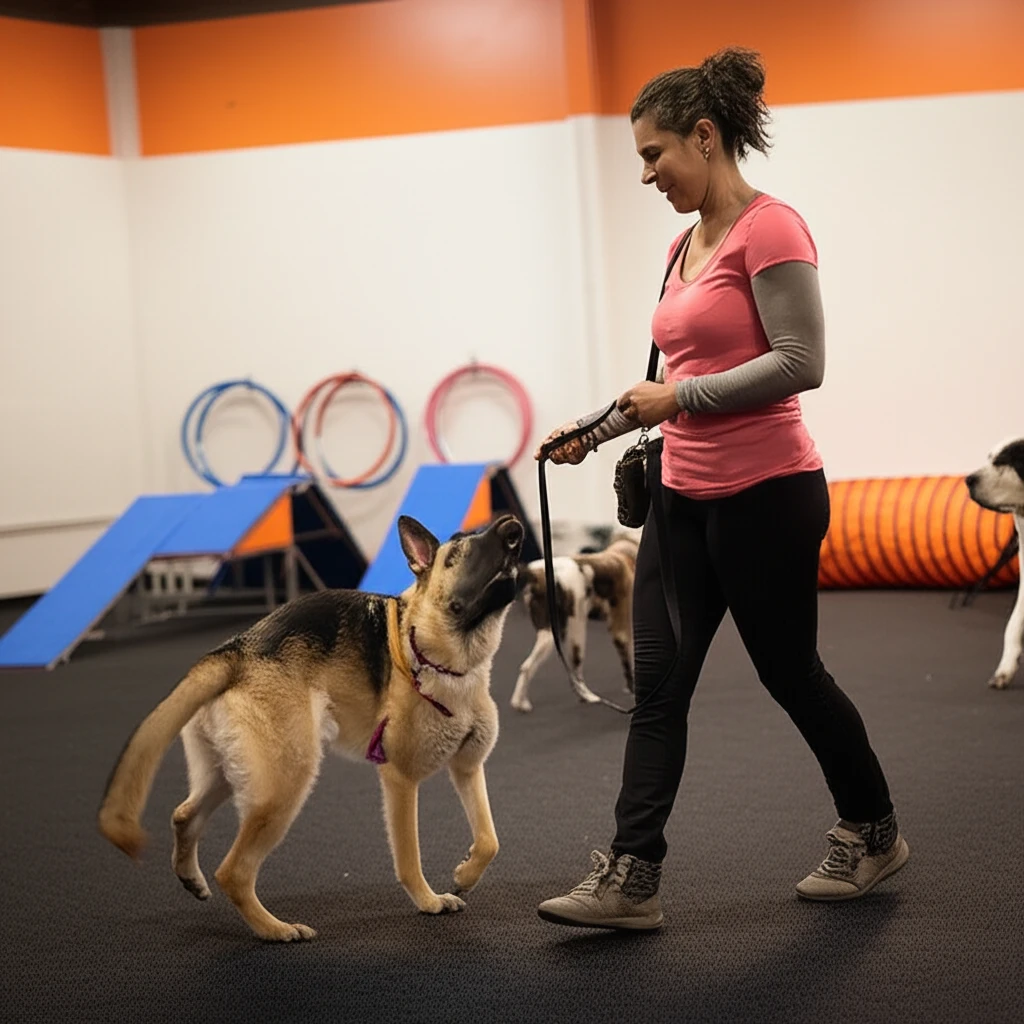
Get structured exposure. Working on this in the real world is hard because you can't control the variables. You don't get to decide when a dog will appear, how close they'll come, or whether the other dog is calm or pulling too. A structured training class environment is worth more than a hundred survival walks, because the distances are managed, the other dogs are under guidance, and your dog gets to practice being around other dogs without being flooded. That kind of controlled, positive exposure builds real confidence.
The Bigger Picture
Leash reactivity is not a verdict on your dog's character, and it's not a reflection of your failure as an owner. It means your dog hasn't had enough positive, structured exposure to other dogs in situations where they felt safe. That's it. It's a gap in experience, not a permanent personality trait.
The dogs who bark and lunge on the sidewalk are often the same ones who, given the right environment, will play happily in a group, settle calmly at an outdoor restaurant patio, or walk past another dog with nothing more than a curious glance. Getting there takes consistency, patience, and usually some professional guidance -- because it's hard to see your own dog's body language clearly when you're managing the leash and your own stress at the same time.
What connects all of this is socialization -- not just exposure to other dogs, but positive, well-managed exposure that teaches your dog the world is safe and predictable. Puppies who get this early tend to navigate the world more easily. But dogs who missed that window aren't stuck. They just need the work done more deliberately.
If your dog turns every walk into a battle, it doesn't have to stay that way. The right combination of distance management, positive association, and guided practice can change how your dog feels about the world outside your front door. That shift doesn't happen on the first walk or the fifth one, but it does happen. And once your dog starts choosing to look at you instead of lunging toward every dog they see, you'll feel the difference in every step.
Group classes are one of the most effective ways to give a reactive dog the structured, positive exposure they need to build lasting confidence around other dogs.
Frequently Asked Questions
Can an older dog overcome leash reactivity?
Yes. Dogs of any age can make meaningful progress with leash reactivity. The process works the same way regardless of age: find the threshold distance, change the emotional association with other dogs through counter-conditioning, and gradually reduce that distance over time. Older dogs may have more rehearsal history with the reactive behavior, so the timeline can be longer, but the brain's ability to form new associations does not disappear with age. Consistent practice and structured exposure in a group class setting can produce noticeable improvement within a few weeks.
Is leash reactivity the same as aggression?
No. Leash reactivity and aggression are different things, though they can look similar on the surface. Most leash-reactive dogs are reacting out of frustration or fear, not a desire to harm another dog. Many of these same dogs play well off-leash when given the chance to interact naturally. The key difference is the motivation behind the behavior. Reactivity is an emotional overreaction to a trigger. Aggression involves intent to cause harm. A qualified trainer can help you determine which you are dealing with and tailor the approach accordingly.
How long does it take to see improvement with leash reactivity training?
Most owners begin to see small improvements within two to four weeks of consistent counter-conditioning work. The timeline depends on the severity of the reactivity, how long the pattern has been practiced, and how consistently you can manage the training environment. Early wins often look like your dog noticing another dog and glancing at you instead of immediately reacting. Full reliability in varied real-world settings typically takes several months. Working with a trainer in a structured class accelerates the process because the distances and distractions are carefully managed.
Ready to get started?
Find your nearest Zoom Room and build your dog's confidence around other dogs.
Find a Zoom Room